
Author: Site Editor Publish Time: 2026-08-20 Origin: Site
Seal failure in high-cycle industrial environments often begins at the microscopic level, where material fatigue eventually leads to macroscopic system failures. When elastomeric materials are subjected to repeated mechanical compression, thermal cycling, and environmental stress over time, they face the risk of permanent deformation. This phenomenon, known as compression set, compromises the integrity of the seal, leading to leaks, contamination, and costly downtime. A high-quality Silicone Rubber Cord solves this problem through its unique molecular structure. The inherent elasticity of the siloxane backbone allows the material to recover its original shape even after thousands of compression cycles. Understanding the material science behind elastomeric recovery is critical for specifying the correct polymer formulation. By matching the right durometer, curing method, and hardware design to the application, engineers can ensure long-term sealing reliability under severe operational stress.
Compression Set Resistance: A low compression set is the defining metric for seal longevity; high-quality formulations bounce back to their original shape even after thousands of cycles.
Molecular Cross-Linking: The inherent siloxane backbone of the material provides superior thermal and mechanical stability compared to traditional organic rubbers.
Application Specificity: Different use cases (e.g., dynamic vs. static, high-heat vs. cryogenic) require specific durometers and filler profiles to prevent premature flattening.
Design Tolerances: Effective sealing relies equally on material properties and engineered gland/groove design to prevent over-compression and extrusion.
Compression set is the percentage of original thickness that a material fails to recover after being compressed under specific conditions of time, temperature, and deflection. It is the primary metric used to evaluate an elastomer's ability to maintain a seal over its operational lifespan. When a material exhibits a high compression set, it permanently flattens, losing the radial force required to block fluid or gas bypass. In field applications, a flattened seal means immediate loss of containment, requiring maintenance intervention and line shutdowns.
Industry standards such as ASTM D395 (Method B) and ISO 815 dictate how compression set is scientifically evaluated. These tests involve compressing a standardized sample to a specific deflection, exposing it to elevated temperatures for a set duration, and then measuring its recovered thickness after a cooling period. Testing parameters must closely match real-world operational temperatures to provide accurate predictive data for field performance. If you test a seal at room temperature but operate it at 150°C, the test data is practically useless for predicting field longevity.
The physics of seal failure center on the breakdown of polymer chains. Under repeated mechanical stress and thermal exposure, the cross-links within inferior elastomeric materials begin to fracture or permanently realign. This molecular degradation manifests as macroscopic flattening. Once the material loses its elastic memory, microscopic leak paths form between the seal and the mating hardware. You will often see this in poorly specified equipment where the seal looks intact but fails pressure testing.
Permanent deformation affects gas and liquid hermetic sealing differently. Gas containment requires significantly higher elastic recovery than liquid retention because gas molecules are smaller and can escape through minute surface imperfections. A seal that has taken a moderate compression set might still successfully retain viscous liquids like heavy oils but will rapidly fail when subjected to pressurized nitrogen or air.
For mission-critical industrial applications, engineers must establish strict success criteria for compression set percentages. While acceptable limits vary by application, continuous dynamic seals generally require a compression set of less than 15% to 20% under operating conditions to ensure sustained performance without premature replacement. Static seals can sometimes tolerate slightly higher percentages, but aiming for the lowest possible compression set always yields a wider safety margin.
The foundation of a silicone rubber sealing cord's performance lies in its siloxane backbone. Unlike traditional organic rubbers that rely on carbon-to-carbon bonds, silicone is built on alternating silicon and oxygen atoms. This unique chemical structure provides exceptional rotational freedom at the molecular level. As a result, the material remains highly flexible and elastic across extreme temperature ranges, typically functioning reliably from -60°C to +230°C without embrittlement or melting. This wide operating window makes it a staple in heavy industry.
Cross-linking density further dictates the material's elastic memory and ability to resist permanent deformation. During the vulcanization process, polymer chains are chemically bonded together to form a three-dimensional network. Platinum-cured silicones generally offer tighter, more consistent cross-linking compared to peroxide-cured variants. This results in superior tear strength, higher purity, and a noticeably lower compression set, making platinum-cured formulations ideal for demanding sealing environments where failure is not an option.
Advanced formulations leverage specialized nanofillers to reinforce the polymer matrix. Fumed silica and precipitated silica are commonly integrated into the compound to prevent polymer chain slippage under load. These microscopic fillers increase the physical strength of the cord, improving tear resistance and tensile strength without sacrificing the inherent flexibility required for effective compression and recovery. The right filler package transforms a basic silicone compound into a high-performance industrial seal.
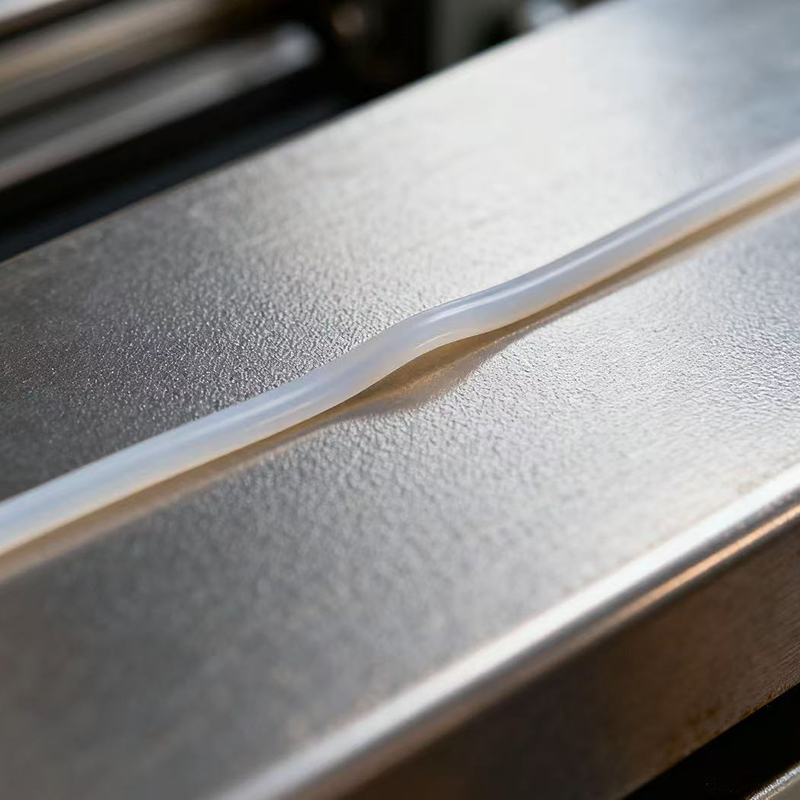
Matching the Shore A hardness (durometer) of the cord to the available compressive load of the hardware is a fundamental design step. Softer cords (e.g., 30-40 Shore A) are necessary for fragile enclosures, plastic housings, or applications with limited clamping force. Conversely, harder cords (e.g., 60-70 Shore A) are required for high-pressure flanges and heavy-duty industrial assemblies where extrusion resistance is paramount. Using a hard cord on a weak plastic housing will warp the hardware before a seal is achieved.
The elastic properties of a high-quality silicone cord allow it to conform seamlessly to surface irregularities. Even precisely machined hardware contains micro-roughness and tooling marks. The elastomer must flow into these microscopic voids under compression to maintain a continuous, gas-tight seal. High elastic recovery ensures that the seal remains firmly pressed against these imperfections even as the hardware shifts or expands thermally during operation.
Dimensional accuracy during continuous extrusion is vital for consistent performance. Profile and extrusion tolerances dictate the uniformity of the cord's cross-section. If the diameter fluctuates along the length of the cord, the compression rate will vary once installed in the groove. This inconsistency creates localized areas of over-compression and under-compression, leading to premature failure and leak paths. Tight manufacturing tolerances are non-negotiable for high-pressure systems.
Environmental and chemical compatibility must also be assessed. While silicone naturally resists UV radiation, ozone, and moisture, exposure to specific industrial chemicals, concentrated acids, or petroleum-based solvents can accelerate material degradation. Swelling or chemical breakdown will rapidly destroy the cross-linked structure, negating the material's compression set resistance. Always verify chemical compatibility charts before specifying a seal for a new fluid type.
Evaluation Dimension | Design Consideration | Impact on Sealing Performance |
|---|---|---|
Durometer (Shore A) | Match to hardware clamping force | Prevents crushing of fragile parts; stops high-pressure extrusion. |
Extrusion Tolerances | Ensure uniform cross-sectional diameter | Maintains consistent compression rates across the entire seal length. |
Surface Conformability | Ability to fill micro-roughness | Creates a continuous barrier against gas and liquid bypass. |
Chemical Compatibility | Resistance to operational fluids/gases | Prevents swelling, embrittlement, and loss of elastic memory. |
High-volume food and beverage canning lines operate under extreme operational demands. A canning machine sealing cord must endure rapid, repeated compression cycles, often exceeding hundreds of thousands of actuations per month. The seal must compress instantly to form a vacuum or pressure barrier, then recover immediately for the next cycle without losing its structural integrity. Any lag in recovery results in rejected cans and lost production.
Compliance and hygiene are equally critical in these environments. The formulations used must meet FDA compliance standards and resist degradation from aggressive Clean-In-Place (CIP) washdown chemicals. The cord must maintain its mechanical memory and sealing integrity despite frequent exposure to caustic cleaners, high-pressure steam, and extreme temperature fluctuations during sterilization processes. Material degradation here leads directly to contamination risks.
Electric vehicle infrastructure and consumer electronics rely heavily on robust environmental sealing. A charging port sealing cable is deployed to block moisture, dust, and debris, ensuring IP67 or IP68 ratings under varying outdoor exposure. These seals protect sensitive high-voltage components from environmental ingress that could cause short circuits or corrosion. A failed seal in an EV charger can lead to catastrophic electrical failures.
These applications subject the seal to combined thermal-mechanical stress. The sealing cable must survive unpredictable, repeated physical insertion and extraction cycles by end-users. Furthermore, it must maintain its elasticity across extreme temperature fluctuations, ranging from sub-zero winter environments to intense solar heat loads, without taking a permanent compression set. The material must perform flawlessly regardless of the weather conditions.
Engineers must evaluate the conceptual trade-offs between using a spliced continuous cord and a fully molded custom silicone gasket. Extruded cord offers significant scalability and cost-efficiency for large enclosures or standard circular static seals. It can be cut to length and vulcanized into O-rings quickly, reducing tooling lead times and upfront engineering costs.
The decision threshold for transitioning to a custom-molded solution depends on application complexity. When hardware involves complex geometries, sharp corners, multi-directional stress, or extreme pressure requirements, a custom gasket is necessary. Molded gaskets eliminate the potential weak point of a splice joint and allow for variable cross-sections designed specifically for the mating hardware. If the groove path is highly irregular, molding is the only reliable option.
Over-compression is a primary risk when implementing elastomeric seals. Compressing a silicone cord beyond its elastic limit—typically greater than 30% for standard solid profiles—permanently damages the polymer structure, leading to immediate compression set and eventual mechanical rupture. To mitigate this, engineers must calculate precise gland fill percentages and utilize hardware stops (metal-to-metal contact points) to control maximum deflection. Never rely on torque specs alone to control compression on an elastomer.
Improper groove design poses another significant threat to seal longevity. Insufficient volume in the hardware groove leads to seal extrusion or pinching under pressure. Because elastomers are essentially incompressible liquids, they must have space to deform into. Grooves must be designed to account for both the volume of the seal and the anticipated thermal expansion of the material at maximum operating temperatures. A groove that is 100% filled at room temperature will extrude and shear the seal when heated.
Splicing failures represent a vulnerability in O-rings manufactured from extruded cord. The vulcanized joint can become a weak point if subjected to excessive tensile stress or uneven compression. To mitigate this risk, specify high-strength vulcanization techniques that match the base material's properties. Additionally, test splice joints rigorously for tensile strength and compression consistency before full-scale deployment. A weak splice will separate under pressure, causing immediate system failure.
Calculate maximum gland fill at the highest expected operating temperature to prevent thermal extrusion.
Implement metal-to-metal hardware stops to physically prevent compression beyond 30%.
Specify platinum-cured formulations for any application requiring rapid dynamic recovery.
Test vulcanized splice joints for tensile strength matching at least 70% of the base cord strength.
Maintaining a reliable seal under repeated compression requires specifying low-compression-set formulations paired with exact hardware tolerances. The inherent elasticity of the siloxane backbone provides the necessary recovery, but the final performance depends heavily on proper integration. Selecting the right durometer, curing method, and form factor—whether an extruded cord or a custom gasket—must be driven by cycle frequency, environmental exposure, and clamping force. Careful attention to groove design and compression limits will prevent premature material fatigue.
Request detailed material data sheets (MDS) to verify compression set percentages under your specific operating temperatures.
Order prototype samples to conduct physical compression and thermal cycling tests within your actual hardware.
Consult with application engineers to review and optimize your gland and groove dimensions before finalizing production tooling.
A: For most industrial sealing applications, a compression set of less than 20% to 25% (tested at operational temperatures) is considered acceptable. Highly dynamic applications may require specialized formulations that achieve a compression set below 15% to ensure rapid recovery and long-term reliability.
A: Elevated temperatures accelerate polymer chain relaxation and cross-link degradation, increasing the compression set. However, silicone maintains its elastic recovery far better than organic rubbers at extreme temperatures, typically functioning reliably up to 230°C without permanent flattening.
A: Yes, provided the formulation has a low compression set and high tear strength. However, for high-friction or high-speed dynamic applications, surface treatments or specific durometers must be selected to minimize wear and prevent the cord from rolling in the groove.
A: Platinum-cured silicone generally exhibits a tighter cross-link density, resulting in a lower compression set, higher purity, and better tear strength. Peroxide-cured silicone is robust but often has a slightly higher compression set and may leave trace byproducts.
A: The inner diameter stretch should ideally be kept under 5% to prevent cross-sectional reduction. Compression ratio (deflection) should typically range between 10% and 30%, depending on the cord's durometer and whether the application is static or dynamic.
A: Permanent flattening occurs when the material is over-compressed beyond its elastic limit or exposed to temperatures exceeding its rating, breaking molecular bonds. Prevent this by using hardware stops to limit compression to 30% and selecting high-recovery formulations.
A: ASTM D395 (Method B) and ISO 815 are the primary international standards used to measure compression set. These tests evaluate the material's ability to recover its original thickness after being compressed at a specific temperature for a defined period.


