


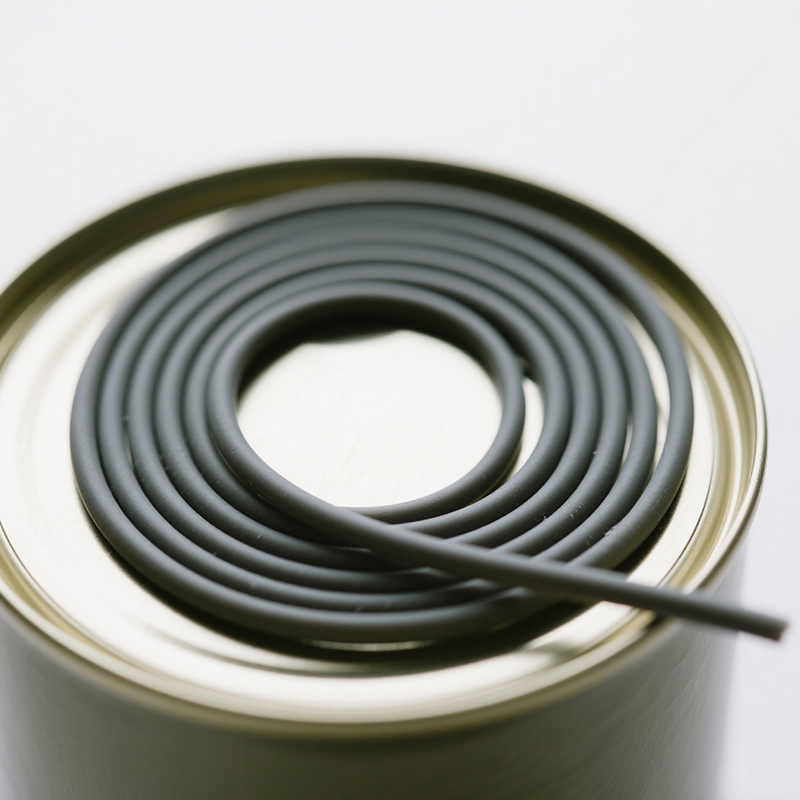


Core performance advantages
1. Accurate sealing and efficiency: high-purity food-grade silicone is used, which has excellent elasticity and resilience. It can closely fit the sealing groove of the can sealing machine and the edge of the can mouth, forming a uniform and stable sealing surface, effectively preventing the leakage and oxidation of canned contents, and ensuring the shelf life of food (the sealing qualification rate can reach more than 99.9%) .
2. High temperature resistance and ageing resistance: It can withstand 120-180℃ high temperature for a long time (adapted to the sealing machine heating and sealing process), and it does not deform, melt, and odourless when exposed to heat; at the same time, it is ozone-resistant, fatigue-resistant, and remains elastic after repeated squeezing and friction. The service life is 2-3 times that of ordinary rubber sealing wire.
3. Food-grade safety compliance: It meets FDA, GB 4086 and other international food safety standards, does not contain BPA, plasticisers and other harmful substances, has no risk of migration indirect contact with food, and is suitable for the sealing needs of various canned foods such as meat, fruits and vegetables, sauces, etc.
Adaptation and use characteristics
1. Customised adaptability: The cross-sectional size (diameter 0.5-5mm), length and hardness (Shaw's 30-70A) can be customised according to the sealing machine model (fully automatic, semi-automatic) and tank type (round, square, shaped tank) to ensure accurate matching with the sealing groove and avoid sealing failure due to size deviation.
2. Easy to install and maintain: The flexible material is easy to embed in the sealing groove of the sealing machine without professional tools; the surface is smooth and not easy to stick to oil and food residue. When cleaning, it can be wiped with warm water + neutral detergent, which is easy to disassemble and replace, and does not affect the efficiency of the production line.
3. Stable mechanical compatibility: excellent wear resistance, can withstand the high-frequency pressing action of the sealing machine (30-120 times per minute), and does not react chemically with the metal parts of the sealing machine to avoid scratching the equipment or producing debris to pollute the cans.
Highlights of added value
1. Multifunctional enhanced design: some products add anti-adhesion coating to prevent adhesion to the mouth of the tank after heating; or adopt a composite structure (such as silicone fibre) to enhance the tear resistance and adapt to the sealing needs of high-pressure sterilised cans.
2. Outstanding cost-effectiveness: Although the single procurement cost is slightly higher, it can reduce the downtime and maintenance time of consumables and the replacement cost of consumables due to ageing resistance and frequent replacement; at the same time, the stable sealing performance reduces the canning sub-quality rate and improves production efficiency.
FAQ:
I. The problem of sealing performance
1. Q: When the sealing machine is used, the seal is not tight, and the can leak/flatulence occurs. Is it a problem of sealing the thin line?
A: It may be. First, check whether the sealing thin line is peeled off, deformed or there is oil/ofogeny matter on the surface, resulting in the inability to fit tightly to the seal; if the thin line is intact, then check the equipment problems such as insufficient temperature of the seal, uneven pressure or uneven edge of the canned seal.
2. Q: In the same sealing machine, some of the cans are well sealed and some of them are leaking. What is the reason?
A: It is likely that the sealing fine wire is locally worn (such as thinning in the middle section), there is a small notch, or it is not completely stuck in the sealing groove during installation, resulting in poor local fitting. It is necessary to replace the new thin wire and recalibrate the installation position.
II. Wear and ageing problems
1. Q: The surface of the sealed fine wire is hairy and cracked after a period of use. Does it need to be replaced?
A: Yes. Mouling and cracking will destroy the integrity of the sealing surface, lead to the failure of the seal, and may cause residual debris to contaminate the food. It is recommended to immediately replace the silicone sealing line that meets food-grade standards.
2. Q: Why is the sealing machine frequently used, the sealing thin line ageing faster?
A: Due to the long-term repeated squeezing of the high temperature (usually 150-200℃) and mechanical pressure of the sealing machine, the elasticity and weather resistance of silicone will accelerate the decline; if it comes into contact with acidic/oily food residue and is not cleaned in time, it will also accelerate ageing.
III. Installation and adaptation issues
1. Q: After replacing the sealing thin wire, the thin wire shifts frequently when the sealing machine is running. How to solve it?
A: Before installation, clean the sealing groove of the sealing machine to ensure that there are no oil stains and foreign matter; choose a thin wire that matches the size of the sealing groove (too thin to shift, too coarse to squeeze and deform), and apply a small amount of food-grade silicone grease in the groove to assist in fixing.
2. Q: I can't find the sealed fine wire of the same model. Can I replace it with other specifications?
A: It can be replaced temporarily, but two conditions need to be met: 1 The material is food-grade silicone (in line with the GB 4806 standard); 2 The cross-sectional size (diameter/width) is consistent with the original thin line to avoid affecting the sealing pressure and fit due to size deviation.
IV. Cleaning and maintenance issues
1. Q: There is food residue on the sealed fine line. How to clean it so as not to damage it?
A: After each use, wait for the sealing machine to cool down, and gently brush with a soft brush soaked in warm water + neutral detergent; avoid using strong solvents such as wire balls, hard brushes or alcohol to prevent scratches or accelerate the ageing of silicone.
2. Q: How to extend the service life of the silicone sealing wire of the sealing machine?
A: 1 Clean regularly to avoid the accumulation of food residues; 2 Control the sealing temperature within the recommended range of the equipment (not exceeding 220℃) and avoid overheat baking; 3 Keep the sealing machine dry when idle to avoid the growth of mould in a humid environment.
V. Other frequently asked questions
1. Q: The newly replaced sealed thin wire has a slight silicone smell. Will it pollute canned food?
A: No. Food-grade silicone thin line that meets the standard, the slight smell at the time of new use will dissipate after the first high-temperature sealing; it can be run empty for 2-3 times (high temperature mode) first, and then it can be used to seal food after the smell disappears.
2. Q: What is the reason for the situation that the sealed thin wire "cannot bounce back after flattening"?
A: The main reason is that the silicone is "permanently deformed" under high temperature and high pressure for a long time. It loses its elasticity and cannot form an effective seal. It is necessary to replace the new thin line immediately, and check whether the pressure of the sealing machine is too high.

