
Author: Site Editor Publish Time: 2026-08-01 Origin: Site
Sourcing non-standard, large-diameter, or custom-profile seals creates a severe engineering bottleneck. Standard molded O-rings frequently fail to meet the dimensional requirements of specialized equipment. This forces engineers to choose between compromising on design or absorbing high custom-mold expenses and extended lead times. Extruded silicone cord serves as the foundational material for creating custom-sized sealing rings without these drawbacks. You can achieve exact dimensions without the overhead of heavy tooling. However, the reliability of a custom seal depends entirely on the method used to join the cord ends. A weak joint compromises the entire system, leading to leaks and equipment failure. We will evaluate vulcanization versus cold bonding to show how you can achieve optimal seal integrity and maintain strict performance standards across your hardware applications.
Process Superiority: Vulcanization (hot splicing) creates a chemical bond that maintains the flexibility and thermal resistance of the original silicone rubber cord, far outperforming cold glued joints.
Application Versatility: Custom spliced rings are critical for specialized industrial applications, ranging from high-temperature canning machine sealing cord to weather-resistant charging port sealing cables.
Cost Efficiency: Utilizing extruded cord stock eliminates the need for expensive custom molds, making it the most viable option for low-to-medium volume production runs and rapid prototyping.
Quality Dependency: The structural integrity of a joined ring relies on exact measurement, precise cutting, secure mold alignment, and controlled curing parameters to prevent weak points at the seam.
Standard fully molded O-rings present strict limitations in custom manufacturing. You face fixed diameters, long lead times, and prohibitive tooling costs. When equipment designs fall outside standard AS568 sizes, engineers must find alternative sealing solutions. Relying solely on custom molded parts slows down development cycles. It also ties up capital in tooling that may require multiple revisions before reaching the final production stage. Spliced rings offer a highly effective alternative for dynamic and static sealing environments.
Designing a custom flange or housing often dictates a non-standard groove diameter. If you restrict your design to off-the-shelf molded O-rings, you compromise the optimal geometry of your hardware. Extruded cord allows the seal to adapt to the hardware, rather than forcing the hardware to adapt to the seal. This flexibility proves invaluable across industrial sectors where equipment dimensions vary wildly.
Cutting a new mold requires significant upfront capital expenditure. A multi-cavity steel mold for a large-diameter O-ring can cost thousands of dollars and take four to eight weeks to machine. Purchasing continuous extruded cord stock bypasses this barrier entirely. You can cut the cord to any required length immediately. This provides massive timeline advantages for rapid prototyping.
Iterative design phases proceed without waiting weeks for mold revisions. Engineers can test multiple seal diameters in a single day. You simply cut a new length of cord and splice it. This agility keeps hardware development on schedule and allows for rapid adjustments based on physical testing feedback. The prototyping workflow typically follows these steps:
Identify the required cross-section diameter based on the machined groove depth and width.
Cut multiple lengths of cord to test different inner diameters and stretch percentages.
Splice the prototypes using hot vulcanization to replicate production-grade strength.
Install and pressure-test the seals in the physical hardware under operational loads.
Finalize the exact cut length specification for the production run.
Different environments demand specialized material properties. Consider the rigorous requirements for a canning machine sealing cord. It needs FDA compliance, high-temperature resistance, and large-diameter continuous sealing capabilities. Food packaging equipment operates at high speeds under intense thermal stress. The seal must maintain its integrity without degrading or contaminating the product over thousands of operational hours. A spliced ring allows for the massive diameters required by industrial rotary canning lines without the impossible logistics of molding a six-foot-wide O-ring.
Conversely, a charging port sealing cable requires distinct characteristics. EV infrastructure demands IP67 or IP68 ingress protection. It requires high ozone resistance and tight compression set requirements. The seal must block moisture effectively during heavy rain or pressure washing. It must also withstand constant plugging and unplugging without losing its shape or allowing environmental contaminants to breach the electrical contacts. Spliced silicone rings provide the exact durometer and weatherability needed for these outdoor enclosures.
Engineers generally rely on two primary techniques to join extruded cord into closed rings. Each method offers vastly different mechanical outcomes. Choosing the wrong method leads to catastrophic seal failure in the field. Understanding the mechanics of each approach ensures you specify the correct joint for your application.
Vulcanization represents the gold standard for splicing. The process involves applying uncured liquid silicone to the cut ends of a Silicone Rubber Cord. This liquid must match the base material's durometer and compound precisely. Operators then apply heat and pressure within a precise mold. This triggers a cross-linking chemical reaction.
The polymer chains fuse together, creating a seamless, homogenous joint. The resulting bond acts as a continuous piece of rubber. It flexes and stretches just like the parent material. This method ensures the joint does not become a weak point under mechanical stress or thermal expansion. Hot splicing is mandatory for any application involving fluid pressure, vacuum environments, or extreme temperature cycling.
Cold gluing utilizes specialized silicone adhesives to bond the ends at room temperature. Operators apply the glue and press the ends together manually. This method carries critical limitations. The resulting joint is often brittle. It lacks the thermal resistance of the base material.
You should never use cold bonding for dynamic or high-pressure applications. The adhesive breaks down when exposed to harsh chemicals or extreme temperature fluctuations. It serves best as a temporary fix or for low-demand static displays where environmental stress remains minimal. If a cold-bonded ring is stretched during installation, the adhesive joint will likely snap, rendering the seal useless.
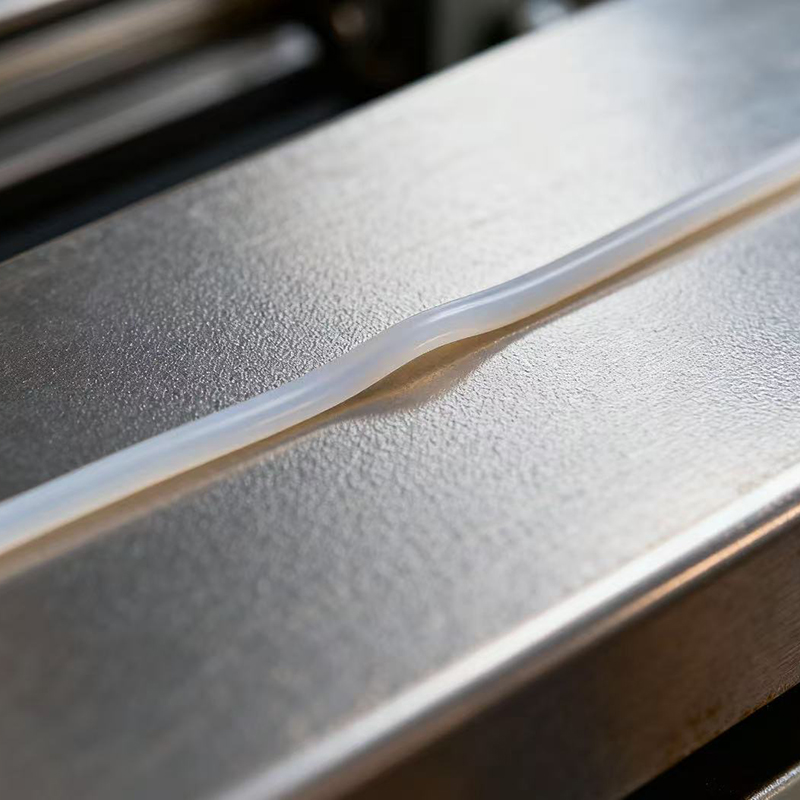
Creating a reliable seal requires strict adherence to a controlled manufacturing process. Skipping steps or ignoring tolerances leads to weak joints and compromised hardware. The vulcanization process demands precision at every stage, from the initial cut to the final deflashing.
Calculating the exact cut length stands as the critical first step. You must base this on the required inner diameter and cross-section. Use the standard formula involving the mean diameter to determine the flat length accurately. The formula is: Cut Length = (Inner Diameter + Cross Section) × π. Engineers must account for stretch allowances and compression factors.
This ensures the final custom silicone gasket fits the hardware perfectly. Excessive tension will cause premature failure and thin out the cross-section. We generally recommend a stretch allowance of 1% to 3% for the inner diameter. Never exceed 5% stretch, as this reduces the cross-sectional thickness and compromises the gland fill. Too much slack causes the seal to bunch up within the groove, creating immediate leak paths.
You need perfectly square 90-degree cuts. Sometimes a precise 45-degree scarf joint works better to maximize surface area, particularly for hollow profiles or sponge cords. Flush contact is non-negotiable for a strong bond. We use specialized guillotine cutters with un-serrated blades to ensure a clean, flat face. Scissors or standard utility knives create jagged edges that trap air and weaken the splice.
Strict cleaning protocols are required before applying the uncured silicone. You must remove surface contaminants, oils, or mold release agents from the cord ends. Isopropyl alcohol or approved industrial solvents work best. Any residue left on the surface will inhibit the cross-linking reaction and weaken the joint permanently. Operators must wear lint-free gloves during this stage to prevent transferring skin oils to the bonding surface.
Operators use precision splicing molds, often called heater blocks. These are machined from aluminum or steel to the exact profile and diameter of the cord. The cavity must match the cord perfectly to prevent distortion. Secure clamping pressure ensures tight contact between the ends. This prevents the liquid silicone from flashing excessively.
It guarantees a void-free joint. If the clamping pressure is too low, the joint will swell and exceed dimensional tolerances, creating a bulge that will not fit into the hardware groove. If the pressure is too high, it pinches and weakens the cord structure, creating a bottleneck in the cross-section. Modern splicing machines use pneumatic clamps to deliver consistent, repeatable pressure across every joint in a production batch.
Time and temperature variables dictate a full cure. These depend heavily on the cord's durometer and cross-sectional thickness. Standard solid silicone typically cures between 170°C and 200°C. Thicker cords require longer dwell times in the heater block to ensure the core reaches the activation temperature. Under-curing leaves the center of the joint soft and prone to tearing.
The post-cure finishing process involves removing excess flash. Flash is the small amount of material that squeezes out between the mold halves. This can be done manually with precision blades or through automated trimming machines. Proper flash removal ensures the seal seats properly in its hardware groove. Leftover flash creates leak paths and causes uneven compression distribution along the sealing face.
Engineers need a reliable framework to assess the quality of a spliced joint against a fully molded ring. Visual inspection alone is never enough to guarantee field performance. You must subject prototype rings to rigorous mechanical testing to validate the splicing process.
A properly vulcanized joint should retain approximately 70 to 90 percent of the tensile strength found in the continuous cord. You can verify this through standard pull testing protocols like ASTM D412. While a spliced ring will always break at the joint under extreme tension, it should easily withstand the moderate stretching required for installation.
Compression set at the joint directly affects long-term sealing efficacy. When the ring remains compressed over time, the joint must resist permanent deformation. It must rebound at the same rate as the parent material to maintain a tight seal against the mating hardware surfaces. We test this using ASTM D395 standards, compressing the joint at elevated temperatures for 22 hours and measuring its recovery.
A custom spliced ring deforms between two flat and smooth surfaces or within a machined groove. The groove dimensions dictate how the seal behaves under pressure. Proper compression energizes the seal. It presses the material firmly into the gland walls. We target a gland fill of 70% to 85%, leaving enough room for thermal expansion without extruding the rubber out of the gap.
This ensures the vulcanized joint performs reliably under environmental or fluid pressure. The joint must not create a hard spot that resists compression differently than the rest of the ring. Uniform deformation is critical for high-pressure containment. If the joint is harder than the parent material, it will create a localized pressure point that can damage plastic housings or create a micro-leak in metal flanges.
You must verify that a vulcanized joint maintains the exact same temperature rating as the parent cord. This typically ranges from -60°C to +230°C for standard silicone compounds. High-temperature specialty grades can push this limit to 300°C. The chemical resistance profile must also match perfectly.
Adhesive joints fail this parity test, but hot vulcanization passes it easily. The cross-linked joint withstands the same oils, solvents, and UV exposure as the extruded cord without degrading prematurely. This parity is essential for outdoor enclosures, automotive applications, and food processing equipment where harsh cleaning chemicals are used daily.
Sourcing and installing custom spliced rings carries specific implementation risks and potential failure modes. Awareness of these risks prevents costly field failures and warranty claims. Quality control must extend from the supplier's manufacturing floor to your assembly line.
Poor manufacturing leaves obvious signs. Step-mismatch occurs when ends misalign in the mold. This creates a ridge that causes immediate leaks, as the seal cannot sit flat in the groove. Incomplete curing leaves tacky joints that pull apart easily under minimal strain.
Internal voids appear as air bubbles trapped during clamping. These voids act as stress concentrators, leading to sudden rupture under pressure spikes. You can often spot voids by bending the joint sharply and looking for pale spots or surface depressions. Over-curing makes the joint brittle, causing it to crack when stretched over a flange.
Common Splicing Defects and Root Causes
Defect Type | Visual Indicator | Root Cause in Manufacturing |
|---|---|---|
Step-Mismatch | Uneven ridge at the joint | Misaligned mold halves or incorrect cord placement |
Internal Voids | Bubbles or depressions | Trapped air, insufficient clamping pressure |
Under-Cure | Tacky surface, weak bond | Low mold temperature, insufficient dwell time |
Over-Cure | Brittle, discolored joint | Excessive heat, prolonged dwell time |
Excessive Flash | Thick rubber wings at seam | Too much liquid silicone applied, poor mold seal |
Fitting and installing the elastomer ring into grooves requires care. You must not damage the seam during assembly. Use proper lubrication if the application allows it to reduce friction. Silicone-based lubricants should be avoided with silicone rings, as they can cause the material to swell. Use PTFE or synthetic hydrocarbon lubricants instead.
Avoid twisting the cord during insertion. A twisted O-ring will fail prematurely due to uneven stress distribution. Ensure the spliced joint never sits at sharp corners or high-stress pinch points. Place the joint along a straight run of the groove whenever possible to minimize localized stress. Train assembly line workers to handle spliced rings gently, avoiding sharp picks or screwdrivers during installation.
Vetting manufacturing partners is crucial for maintaining quality. Ask specific questions during the procurement phase to ensure they have the technical capability to produce reliable spliced rings.
Do they use dedicated splicing molds for specific profiles, or do they rely on generic flat blocks?
Do they perform batch tensile testing on their joints and provide the data?
Can they provide documentation of their curing parameters for your specific material?
Do they have automated flash removal capabilities to ensure dimensional consistency?
What is their standard tolerance for cut length and joint thickness?
Specify exact tolerances for the joint area in your procurement documents. Define the allowable flash thickness clearly. Request a first-article inspection report before approving full production runs. This report should include dimensional verification, tensile strength data, and visual inspection criteria.
Final procurement decisions depend heavily on volume and application criticality. You must weigh the upfront savings against long-term performance requirements. Understanding the break-even points helps engineers allocate their budgets effectively.
Spliced rings offer superior returns for low-to-medium volumes, typically between 10 and 5,000 units. They are also ideal for exceptionally large diameters where molding is physically impossible or financially ruinous. If you need a seal with a three-foot diameter, splicing is your only realistic option.
For high-volume, standardized OEM production exceeding 100,000 units, a multi-cavity compression mold becomes more cost-effective per unit. The initial tooling cost amortizes quickly at that massive scale. Molded rings also eliminate the manual labor associated with cutting and splicing, reducing the per-part cost significantly in high volumes.
Production Method Comparison
Feature | Vulcanized Spliced Cord | Fully Molded Ring | Cold Bonded Cord |
|---|---|---|---|
Tooling Cost | Very Low | High | None |
Lead Time | Days | Weeks to Months | Hours |
Joint Strength | 70% - 90% of parent material | 100% (No joint) | Low (Brittle) |
Thermal Resistance | Excellent (Matches parent) | Excellent | Poor |
Ideal Volume | Low to Medium (10 - 5,000) | High (100,000+) | Prototyping only |
Diameter Limits | Unlimited | Restricted by press size | Unlimited |
Define your required cord profile, durometer, and exact cut length based on your specific hardware groove dimensions and stretch allowances.
Select a manufacturing partner capable of hot vulcanization and request a prototype ring for physical hardware fit-testing.
Establish acceptable joint tolerances, flash limits, and tensile strength requirements in your procurement documentation.
Conduct field tests under actual thermal and fluid pressure conditions to verify the joint integrity before approving full production.
A: A hot-vulcanized joint retains up to 90 percent of the parent material's tensile strength. This makes it highly reliable for static applications. However, fully molded rings are generally preferred for heavy dynamic stress environments where continuous friction occurs.
A: Cyanoacrylate adhesives can bond silicone, but the joint becomes rigid and loses thermal resistance. Cold bonding is suitable only for temporary fixes or low-stress static environments. It should never be used in critical industrial applications.
A: You must calculate stretch and compression factors to determine the exact length. Use specialized guillotine cutters or sharp, un-serrated blades in a customized jig. This ensures a perfectly flush, 90-degree cut for optimal bonding surface area.
A: Liquid silicone is applied to the cut ends of the cord. The joint is placed in a heated mold under pressure. A cross-linking chemical reaction fuses the polymer chains, creating a seamless and homogenous bond that matches the parent material.
A: Flash is the excess material squeezed out during molding. It is carefully removed using precision trimming tools or automated deflashing equipment. Proper removal ensures the seal seats perfectly within the hardware groove without interference or leak paths.
A: There is no theoretical maximum diameter for a spliced ring. Because it is made from continuous extruded cord, you can create seals that are several meters in diameter, making them perfect for large industrial tanks and rotary equipment.


