


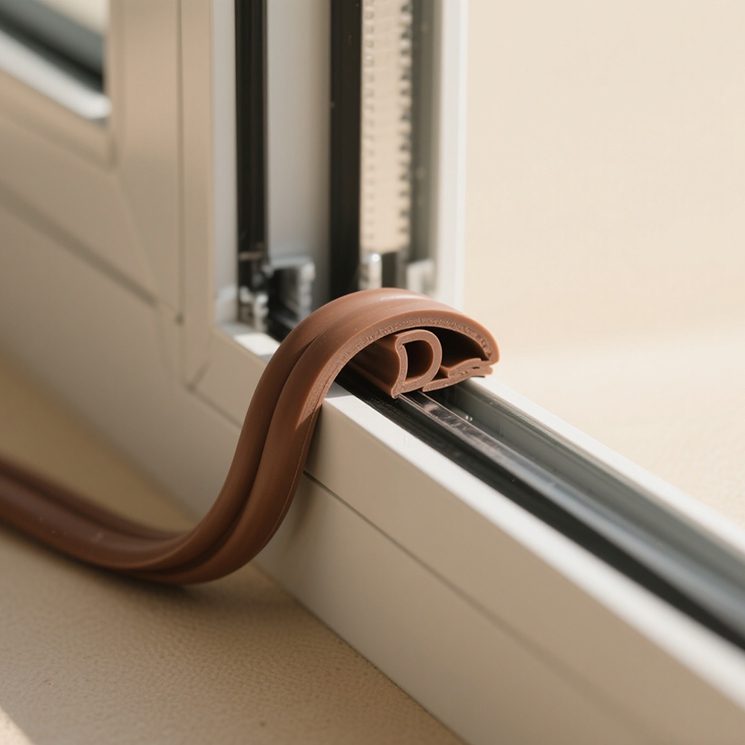


Core performance advantages
1. Strong sealing protection: High-elastic silicone material can tightly fill the gaps between door and window frames and fans, achieve excellent airtightness and watertightness, effectively block wind and rain, sand and dust from infiltrating the room, while isolating outdoor noise (can reduce 15-30 decibels), and improving the quietness of living.
2. Extremely strong weather resistance: it can withstand extreme temperatures of -50℃ to 200℃, excellent resistance to ultraviolet rays, ozone, high and low temperature cycle ageing, long-term exposure to outdoors is not easy to harden, crack and deform, and the service life can reach 8-15 years, far exceeding traditional sealing materials such as rubber.
3. Environmental protection, safety and stability: It adopts food-grade/industrial-grade environmental protection silicone, which does not contain formaldehyde, plasticiser and other harmful substances, and has no odour; and does not chemically react with the metal and profiles of doors and windows, corrosion-resistant and does not breed mould. It is suitable for a variety of door and window materials such as aluminum, plastic and wood.
Characteristics of the usage scenario
1. Significant energy saving and efficiency increase: by blocking hot and cold air convection, reducing the loss of air conditioning and heating energy consumption (energy saving rate can reach 20%-30%), helping buildings achieve low-carbon energy-saving standards, suitable for residential, commercial buildings, industrial plants and other doors and windows.
2. Flexible installation and adaptation: the cross-sectional specifications can be customised according to the size of the door and window gaps (round, square, D-type, etc.), with strong flexibility and can adapt to irregular gaps; installation does not require complex tools, just directly embedding the card slot or pasting, and the later replacement is convenient.
3. Buffer protection function: When opening and closing doors and windows, the silicone sealing ring can buffer the collision impact of the frame and the fan, reduce metal friction noise, and at the same time avoid scratches and deformation on the surface of doors and windows, and extend the overall service life of doors and windows.
Highlights of added value
1. Multi-functional adaptation: some products add flame-retardant ingredients to meet fire protection requirements; or adopt a waterproof backing design to enhance the sealing and waterproofing, which is suitable for humid environments such as kitchens and bathrooms.
2. Low maintenance cost: no special maintenance is required in daily life, just wipe it with a wet cloth after it gets dirty; because of its strong ageing resistance, there is no need to replace it frequently, and the long-term use cost is lower than that of traditional sealing materials.

FAQ:
I. The problem of sealing performance
1. Q: How to solve the problem that the doors and windows are still leaking or leaking?
A: First check whether the sealing ring has fallen off, deformed or has a gap, and if there is a gap, replace it; then confirm whether the installation is in place (whether it is fully embedded in the slot). If the gap is too large, it can be used with sealant; if it is caused by deformation of the door and window profiles, the door and window frame needs to be adjusted first.
2. Q: After using it for a period of time, the sealing effect of the sealing ring becomes worse. What is the reason?
A: The main reason is that long-term sun exposure and rain cause silicone ageing, decrease in elasticity, or dust and oil on the surface affect the fit. If it is still ineffective after cleaning, the new seal needs to be replaced in time.
II. Ageing and loss problems
1. Q: Does the sealing ring need to be replaced if it is cracked, hardened and yellowed?
A: Yes. These are typical manifestations of silicone ageing failure, which will directly affect the sealing, and tiny particles may be produced after ageing. It is recommended to replace the new sealing ring that meets the specifications immediately.
2. Q: Why are the sealing rings in the northern region more easily damaged?
A: Low temperature in winter (up to -30℃ or less) in winter, high temperature in summer, and a large temperature difference between day and night. Silicone is affected by cold and hot cycles for a long time, and the ageing rate is faster than in temperate areas. It is recommended to choose a special sealing ring with stronger low temperature resistance.
III. Installation and adaptation issues
1. Q: What should I do if the size of the sealing ring I bought is not suitable? It can't be installed or it's too loose?
A: Before installation, you need to measure the width, depth and gap size of the door and window slot, and choose the sealing ring corresponding to the cross-section specifications (such as D-type, O-type, square); if it is slightly loose, you can apply a small amount of silicone adhesive in the slot to assist in fixing. If it is too tight, you need to replace the adaptation size.
2. Q: Can wooden doors and windows be equipped with silicone seals? How to install?
A: OK. It is recommended to choose a silicone sealing ring with backing glue for wooden doors and windows, and paste it directly after cleaning the surface of the window frame; if there is a slot, just embed it. Pay attention to avoid nails or screws piercing the sealing ring and destroying the sealing effect.
IV. Cleaning and maintenance issues
1. Q: The surface area of the sealing ring is gray and stained with oil. How to clean it so as not to damage it?
A: Mix neutral detergent (such as detergent) with warm water, wipe it with a soft cloth or sponge, and avoid using strong corrosive detergents such as wire balls, alcohol, gasoline, etc. to prevent silicone ageing and cracking.
2. Q: The sealing rings of kitchen doors and windows are prone to oil stains. How to keep them clean for a long time?
A: After each cleaning of the kitchen, wipe the surface of the sealing ring with a wet cloth; wipe the rag soaked in warm water + baking soda solution once a month, which can effectively remove oil stains and delay ageing.
V. Other frequently asked questions
1. Q: The sealing ring has a strange smell. Is the material not qualified?
A: The new sealing ring may have a slight smell of silicone itself, which will dissipate after 1-2 weeks of ventilation; if the odour is pungent and does not disappear for a long time, it may be because poor-quality recycled silicone is used. It is recommended to replace products that meet environmental protection standards (FDA, LFGB and other certifications).
2. Q: How to deal with the abnormal friction sound of the sealing ring when opening and closing the doors and windows?
A: Check whether the sealing ring is misaligned or there is a foreign body in the slot. After cleaning and resetting, you can apply a small amount of talcum powder or silicon-based lubricant on the surface of the sealing ring (avoid using oil-based lubricant, which is easy to adsorb dust) to reduce friction noise.

