
Core advantages
1. Environmental protection and sustainability: replace disposable plastic straws, reduce white pollution, which is in line with the concept of environmental protection and can be reused hundreds of times.
2. Safe and durable: Food-grade silicone material, resistant to high temperature (usually -40℃ to 230℃), ageing-resistant, plasticiser-free, bisphenol A and other harmful substances, flexible and not easy to break.
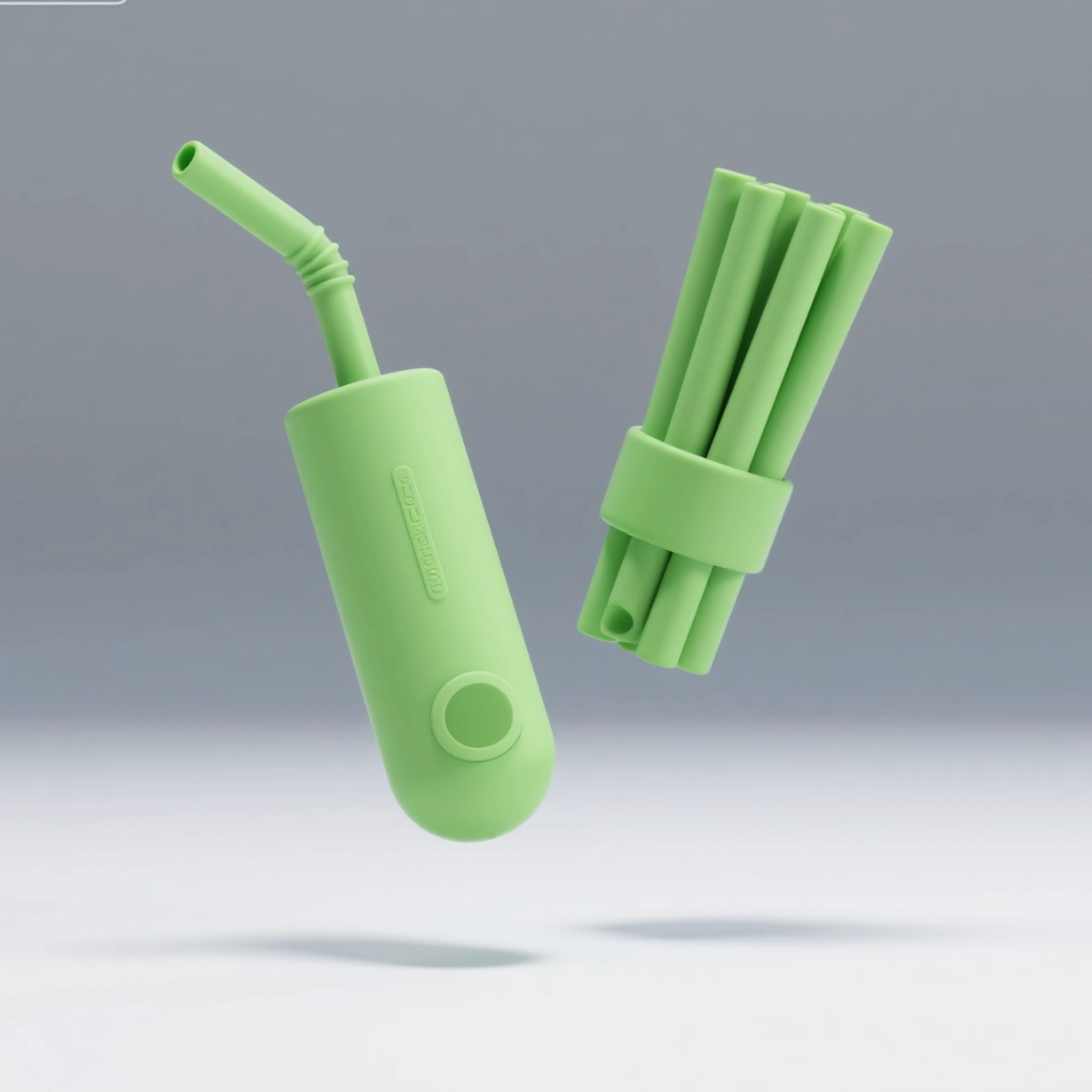
3. Portable and easy to store: can be folded, curled or disassembled, small in size, with a special storage box (mostly the size of a palm), convenient to put in pockets and backpacks, suitable for commuting, travelling, picnics and other scenes.
4. Easy to clean: Most of them are equipped with a special long cleaning brush, which can be cleaned deep inside the straw; some of them support dishwasher cleaning, and it is not easy to breed bacteria after drying.
Product features
1. Humanise the design:
◦ Anti-choking/anti-slip: Some styles of tube mouths are rounded to avoid scratching the mouth; the tail of the straw has anti-slip lines, and it is not easy to fall off when inserted into the cup mouth.
◦ Strong adaptability: the length can be cut or designed as a telescopic type, suitable for different containers such as thermos cups, milk tea cups, coffee cups, etc.
2. Both appearance and practicality:
◦ Colourful appearance: provide a variety of colours such as macarons and morandi to meet personalised needs.
◦ Additional functions: Some storage boxes integrate small functions such as bottle openers and hooks; a few straws have scales, which can assist in controlling the amount of drinking.
3. Flexible scenario adaptation: It is not only suitable for drinking drinks, but also can be used as a temporary sauce transfer tube, children's supplementary feeding aid, etc.
FAQ:
Frequently asked questions and answers about portable silicone straws
1. The straw has a strange smell. How to remove it?
The new portable silicone straw may have a slight smell. You can rinse it with warm water and neutral detergent first, then soak the straw in water with lemon slices or white vinegar for about 30 minutes, and finally rinse it with water and dry it. The odour will usually disappear. Cleaning in time after daily use can also avoid residual odour.
2. It is difficult to clean the straw. What should I do?
You can use a special straw brush to effectively clean the inner wall of the straw. For stains that are difficult to remove, the straw can be soaked in warm baking soda or detergent solution for a period of time before brushing. You can also put it in the dishwasher for cleaning, but make sure that the cleaning mode of the dishwasher will not damage the straw. In addition, try to avoid drinking drinks that are too thick or easy to adhere with a straw.
3. Is it normal for the straw to be easily deformed or broken?
If it is bent, stretched or squeezed by excessive external force, it may be deformed or broken. However, the frequent occurrence of this situation under normal use may be a quality problem. When storing, it is recommended to put the straw in a hard storage box to avoid being squeezed by other items.
4. What is the reason for the faded colour of the straw?
It may be prolonged exposure to direct sunlight or exposure to corrosive chemicals, such as certain juices, detergents, etc. Try to avoid the straw in contact with such items during daily use, and keep it in a place away from light when not in use. If the discolouration is not serious, it will not affect the use; if the discolouration is serious, it is recommended to replace the straw.
5. Can silicone straws be sterilised at high temperature?
Generally speaking, high-quality food-grade silicone straws can withstand a certain high temperature. They can be boiled with boiling water for 3-5 minutes for sterilisation, or they can be sterilised with steam. However, it should be noted that the sterilisation time should not be too long to avoid affecting the service life of the straw. If the material of the straw is unknown or the quality is poor, high-temperature sterilisation is not recommended.
6. How to solve the leakage at the interface of the straw?
First, check whether there is any foreign matter at the interface, clean it up and reinstall it. If the leakage is caused by the ageing or damage of the seal at the interface, you can contact the merchant to buy a new seal for replacement; if you can't buy it separately, you may need to replace the whole straw. When installing, make sure that the interface fits tightly and connects in the correct way.
7. What should I do if the folding straw is not retracted smoothly?
It may be that dirt or foreign matter has accumulated at the fold, which affects the smoothness of the folding. You can clean the straw first, especially the folded part, and then apply a small amount of edible-grade lubricating oil (such as olive oil) on the folded part, and then try to put it away. If it is still not smooth, it may be that the straw itself is structurally damaged and needs to be replaced.
8. Can portable silicone straws be heated in the microwave oven?
Absolutely not. Silicone straws are not suitable containers for microwave ovens. Putting them in the microwave oven for heating will not only damage the straw, but also cause safety accidents, such as fire, explosion, etc. If you need to heat the drink, you should pour it into a microwaveable container for operation.
9. When using it, I feel that the straw can't suck the liquid. What's the problem?
First of all, check whether the straw is blocked by foreign matter. If it's meat, tea, etc., it can be rinsed with water or cleaned with a straw brush. Secondly, check whether the connection between the straw and the cup mouth or container is tight. If there is any looseness, it needs to be reinstalled to ensure that the connection is well sealed. In addition, if the straw is bent excessively, it may also affect the suction of liquid. Just adjust the degree of bending of the straw.


