


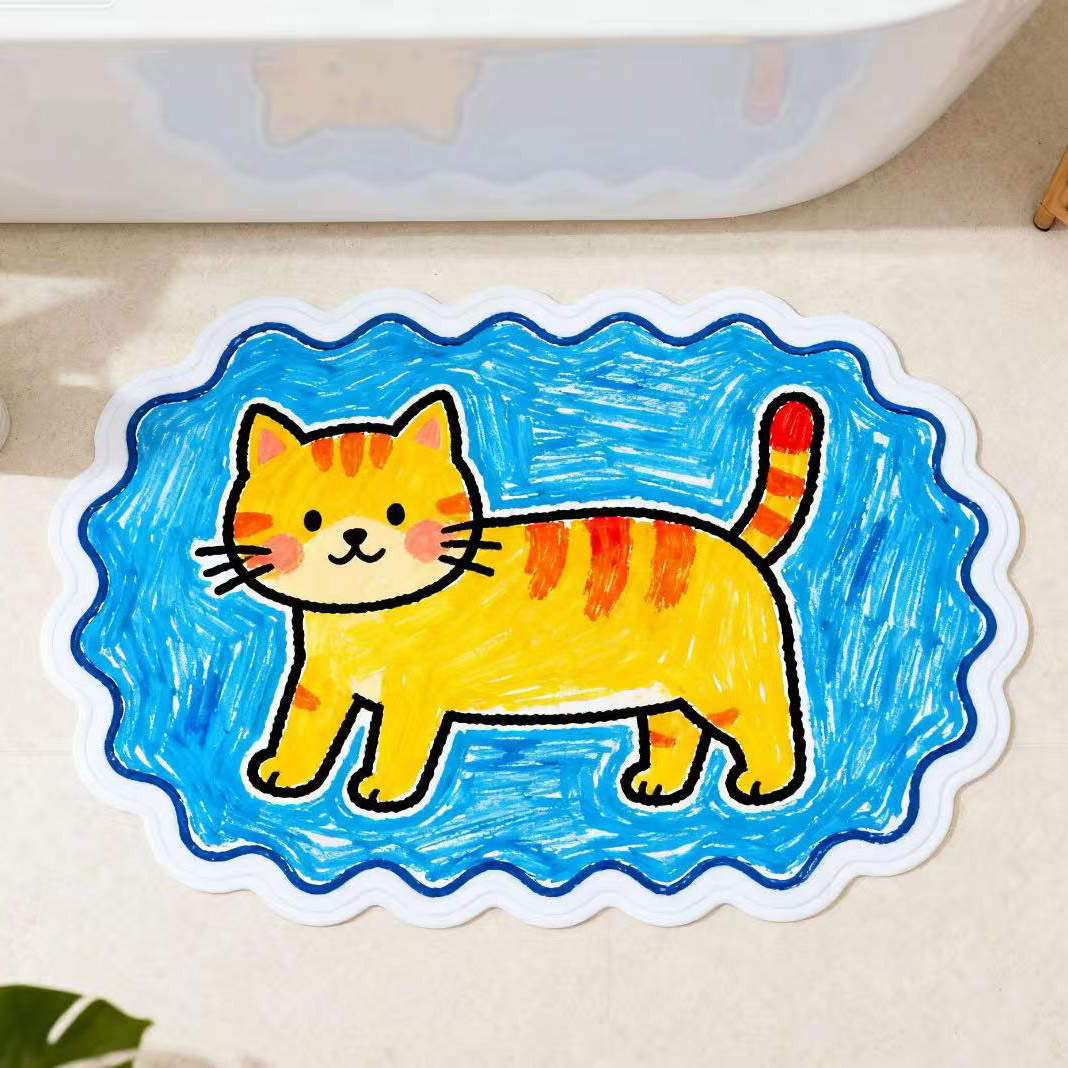


With its material characteristics and scenario-based design, the bathroom anti-slip silicone mat has significant advantages in terms of safety, practicality and experience. At the same time, it has a number of special functions to adapt to the bathroom environment, as follows:
I. Core advantages: directly hit the safety and practical pain points of the bathroom
1. Super anti-slip: dual protection from material to structure
• Material basis: Silicone itself has a high friction coefficient (static friction coefficient ≥0.8, far exceeding 0.4-0.5 of plastic pads). It can still fit the ground tightly in the wet state and is not easy to slide.
• Structural strengthening: The bottom mostly adopts a dense suction cup design (100-200 micro suction cups per square metre). After pressing, the air is discharged to form vacuum adsorption, which can withstand pressure above 80kg without displacement; some styles are matched with diamond/wavy anti-slip surface layer to further enhance the grip of the soles of the feet, especially suitable for the elderly. , for use by children and pregnant women.
2. Safety and environmental protection: food-grade material, no health hazards
• Material compliance: FDA/LFGB certified food-grade silicone, no BPA, heavy metals and harmful chemicals release, even long-term contact with hot water will not decompose the odour (different from the pungent smell of inferior rubber pads).
• Anti-fall protection: Soft silicone material (hardness Shore A 30-40) can cushion the impact of the foot and avoid direct contact with hard tiles when slipping. At the same time, it can protect the surface of the bathroom tiles from scratching furniture (such as bath stools).
3. Durable and weather-resistant: suitable for humid and high-temperature environment in the bathroom
• The temperature resistance range is wide: -40℃~230℃, which can withstand hot water flushing and steam fumigation, and will not age or deform after long-term use (plastic pads are easy to become brittle and crack due to high temperature, and rubber mats are easy to mould and rot).
• Strong corrosion resistance: resistant to the corrosion of daily chemical products such as shower gel, shampoo, disinfectant, no swelling, no discolouration, and the service life can reach 3-5 years (2-3 times that of ordinary anti-slip mats).
4. Easy to clean and maintain: say goodbye to mould and stubborn stains
• Waterproof and mould-proof: the silicone surface is dense and does not absorb water, and the moisture can slip off quickly, which is not easy to grow mould (compared with the fabric pad, which is easy to accumulate water and mouldy, and needs to be dried frequently); some styles add anti-mould agent, and the antibacterial rate is ≥99%.
• Convenient cleaning: Rinse with water can remove hair and foam; stubborn stains can be washed with a soft brush + neutral detergent, or put it directly in the dishwasher for cleaning; high-temperature resistance supports boiling water scalding and alcohol disinfection, which is suitable for household cleaning habits.
II. Scene features: adapt to the whole scene of bathroom use
1. Drainage design: solve the hidden danger of stagnant water and slipping
• The surface layer mostly adopts hollow mesh/bar-shaped drainage holes (pore diameter 2-5mm). When bathing, the water flow can be quickly discharged into the floor leak through the pad body, so as to avoid slipping of the sole of the foot caused by water from the pad area; the bottom edge is slightly raised to further guide the discharge of water flow and keep the cushion surface dry.
2. Comfortable foot feeling: both anti-slip and experience
• The silicone material is soft and elastic, which can fit the curve of the sole of the foot when stepping on it, and relieve the fatigue of the feet after standing for a long time (different from the hard foot feeling of hard plastic pads); some thick models (5-8mm) add a cushioning layer, which is suitable for bathroom washing and soaking feet.
3. Flexible adaptation: multi-size multi-scene coverage
• Various sizes: from the mini model (30×30cm, suitable for the washstand and the edge of the bathtub) to the oversized model (120×80cm, covering the entire floor of the shower area), can be used alone or stitched and combined, suitable for different types of bathrooms.
• Scene subdivision: For different areas such as bathtubs, shower areas, washstands, etc., special styles such as "bathtub anti-slip mat" (arc design with a close to the bathtub curve), "shower area anti-slip mat" (enlarge drainage hole + high suction cup density), "washstand anti-slip mat" (thin and easy to store) are launched.
4. Both appearance and practicality: suitable for home style
• Appearance customisation: support a variety of colours (Morandi colour, macaron colour), patterns (simple stripes, cartoon shape, imitation stone texture), can be matched with different bathroom decoration styles, with both anti-slip and decorative functions.
• Detailed design: the edge is round and burr-free to avoid hanging clothes; some styles are designed with hanging holes, which can be hung and dried after use, saving storage space.
5. Easy installation: no tools required, ready to use
• No need for glue or nails to fix, just point the bottom suction cup at the smooth tile surface and press the exhaust to fix it; tear it off directly when changing the position, and it will not leave glue marks or damage the tile (compared with the disassembly problem of sticky anti-slip mats).
III. The core difference between anti-slip mats and other materials
Material, anti-slip, durability, cleaning difficulty, environmental protection, applicable scenario
Silicone mat ★★★★★ ★★★★★ Low High Shower area, bathtub, washstand
Rubber pad ★★★☆☆ ★★☆☆☆ High (easy to mould) Low Temporary anti-slip
Plastic pad ★★☆☆☆ ★★☆☆☆ Middle (easy to accumulate dirt) Middle Washstand for temporary use
Fabric/plush cushion ★☆☆☆☆ ★☆☆☆☆ High (machine wash required) Medium mainly decorated
In summary, the bathroom anti-slip silicone mat takes "anti-slip safety, durable and easy to clean, and suitable for the scene" as the core advantages. At the same time, it takes into account comfort and appearance through humanised design, which is the first choice category for bathroom safety protection.
FAQ:
The following are the frequently asked questions and practical answers about bathroom anti-slip silicone mats, focussing on core scenarios such as anti-slip safety, cleaning and maintenance, material durability, etc., and providing solutions in combination with daily use needs:
I. Material safety and anti-slip performance
Q1: Is the anti-slip silicone mat in the bathroom safe? Will it release harmful substances?
• Safety standards: Qualified products need to comply with GB 4806.11-2022 (food contact grade silicone standard) or FDA 21 CFR 177.2600, ensuring that formaldehyde, heavy metals (lead, mercury, etc.) are free of migration, and no harmful chemicals are released at room temperature and when exposed to water.
• Material identification: high-quality silicone pads feel soft and elastic (hardness Shore A 30-40), no pungent odour; poor-quality products are mostly recycled silicone, easy to emit plastic smell, white after bending and slow rebound, and long-term use may precipitate harmful substances.
Q2: How to guarantee the anti-slip effect? What designs can improve anti-slip?
• Core anti-slip design:
1. Bottom structure: suction cup type (dense small suction cup adsorbs smooth tiles/glass), grain type (rhombus/wavy pattern increases friction), raised particles (enhancing the bite with the ground), static friction coefficient needs to be ≥0.8 (dry ground), ≥0.6 (wet ground).
2. Surface design: the surface is raised with stripes/dots to increase the friction between the soles of the feet and the cushions, and at the same time, the drainage holes accelerate drainage (to avoid waterlogging).
• Suggestions for use: The ceramic tile floor should be prioritised with a suction cup type; the bathtub/shower area should have a pattern with a drainage hole to prevent water from accumulating under the mat and causing displacement.
Q3: Will it be more slippery after encountering water? Is it suitable for the elderly and children?
• Anti-slip logic: When high-quality silicone encounters water, the surface will form a slight adsorption layer. On the contrary, it fits the ground better than when it is dry and will not fail due to water.
• Adaptation for special groups: The elderly and children need to meet two conditions: 1 the bottom suction cup coverage rate ≥80% (ensure firm adsorption); 2 surface grain depth ≥1mm (increase the sole grip). It is recommended to choose products with "anti-skid certification" (such as EU CE anti-slip test).
II. Cleaning and maintenance
Q4: Is it easy to mould in the bathroom in a humid environment? How to get rid of mould?
• The key to anti-mould: choose a silicone pad with silver ion antibacterial agent (bacteriostatic rate ≥99%), which can inhibit the growth of mould and bacteria; ordinary models need to focus on the "hydrophobic + breathable" design (no closed dead corners at the bottom).
• Mould removal method:
◦ Mild mould spots: brush with toothpaste + soft brush, or rinse and dry after soaking in white vinegar for 15 minutes.
◦ Stubborn mould spots: apply baking soda mixed with hydrogen peroxide (1:1 ratio), leave it for 30 minutes, brush it, and then rinse it with water (avoid contact with skin, it is recommended to wear gloves).
• Preventive tips: Lift the mat after each use to dry the water at the bottom; rinse with hot water (above 60 ℃) once a week to destroy the mould growth environment.
Q5: How to clean the soap scale, hair and dirt on the mat?
• Daily cleaning: After each shower, rinse the surface with water and wipe the soap with your hands or soft cloth; hair can be picked up directly with your hands or cleaned with a sticky hair roller.
• Deep cleaning: once a week, soak it with neutral detergent + warm water for 20 minutes, brush the gap with a soft brush (to avoid scratching the surface of the wire ball), and then rinse it with water and dry it upside down (the bottom is facing up, accelerating drying).
• Contraindications: Do not use strong acid and alkali detergents (such as toilet cleaner and 84 disinfectant), which will corrode the silicone surface and reduce anti-slip and life.
Q6: Can it be machine washed? What should I pay attention to when drying?
• Machine washing adaptor: small foot pads (size ≤60cm×60cm) can be put into the washing machine in a gentle mode for washing, need to be washed separately (avoid wrapping other clothes), and cover the laundry bag to prevent the suction cup from falling off.
• Drying requirements: natural drying is the best; if you need to dry, choose low-temperature drying (≤60℃). High temperature will cause silicone to age and harden, and the suction cup will lose its elasticity.
III. Installation and durability
Q7: How to properly install anti-slip silicone pads? Why did it shift?
• Installation steps:
1. Clean the floor: Wipe the surface of the tile/bathtub with alcohol or white vinegar to remove oil and dust (ensure that the suction cup can be tightly adsorbed).
2. Exhaust adsorption: Lay the mat flat, press the suction cup from the centre to the surrounding area, and exhaust the air (the suction cup is qualified if it completely fits the ground without bulge).
3. Check the fixing: After installation, pull the edge of the mat vigourously. If it is not loose, it will be installed in place.
• Reason for displacement: oil stains/hair on the ground cause the suction cup seal to fail; the suction cup is ageing and loses elasticity; the cushion size is too small (it does not match the use area, and it is easy to be trampled and shifted).
Q8: How long is the service life? Under what circumstances do you need to replace it?
• Normal service life: high-quality silicone mats can be used for 2-3 years; poor-quality products are easy to age due to materials and usually need to be replaced in 6-12 months.
• Change the signal:
1. Anti-slip failure: the suction cup falls off, the bottom grain is worn (friction coefficient <0.5), slight pulling is displaced.
2. Material ageing: the surface hardens, cracks, or stubborn mould spots/discolouration that cannot be cleaned (caused by silicone degradation).
3. Safety hazards: edge warping, blockage of hydrophobic holes (stagnant water cannot be discharged, increasing the risk of slipping).
Q9: How to extend the service life?
• Daily maintenance:
◦ Avoid direct sunlight (ultraviolet accelerates silicone ageing), and regularly move the mat in the bright bathroom.
◦ Do not touch sharp objects (such as razors and tile edges) to prevent scratching the suction cup or surface.
◦ When not in use for a long time, wash and dry it, roll it up and store it (avoid folding to prevent permanent deformation of the indentation).
IV. Selection and adaptation scenarios
Q10: How to choose the mat for the shower area, bathtub and bathroom door?
Scene, core requirements, recommended style, size suggestion
Shower area, water-repant, non-slip, step-resistant, suction cup type + surface stripes + dense water-repyling holes 80cm×100cm or more
Bathtub, fit the bathtub arc, anti-shift, customised curved suction cup, the edge fits the inner wall of the bathtub, adapts to the bottom size of the bathtub
At the entrance of the bathroom, water-absorbing anti-slip, rubbing feet, surface fluff + bottom anti-slip particles (non-suction cup type) 50cm×80cm
Q11: What should I do if the new mat has a strange smell?
• Quick deodorising method:
1. Ventilated drying: keep it in a cool and ventilated place for 24-48 hours to dissipate the odour naturally.
2. Soak to remove odour: Soak with water + a small amount of white vinegar (or lemon slices) for 30 minutes. After drying, the odour is basically eliminated.
3. Activated carbon adsorption: Seal the cushion and activated carbon bag in a plastic bag, and the odour can be removed after 24 hours.
• If there is still a pungent smell after soaking, it may be a poor quality product. It is recommended to replace it to avoid long-term inhalation of harmful gases.
Q12: Will the silicone pad fade? How to avoid staining?
• The reason for discolouration: poor-quality pigments are easy to fall off when exposed to water/cleaners; long-term contact with dark shower gel and shampoo may be stained.
• Prevention and treatment:
◦ When buying, choose a product with "colour fastness ≥4" (the surface can be wiped with a wet tissue, and it is qualified without discolouration).
◦ After dyeing, brush lightly with toothpaste, or soak with baking soda and rinse. For severe staining, you can try to dilute 84 disinfectant (only for white mats, and the concentration should be controlled by ≤1%).
V. Common problems and risk avoidance
Q13: What should I do if the edge of the cushion is warped?
• Temporary repair: Blow the warped edge with a hot air (10cm away) with a hair dryer for 10-15 seconds, press it on the ground while it is hot, and it can be fixed after cooling.
• Long-term solution: If the edge warped frequently, it may be that the size of the mat does not match the ground (too small, it is easy to be trampled and deformed). It is recommended to change to a larger size or a style with a weighted edge.
Q14: Will pet scratching damage the mat? How to protect?
• Durability: The tear strength of the high-quality silicone pad is ≥10kN/m, and it is not easy to break with slight scratching, but the sharp claws may scratch the suction cup.
• Protection advice: The cushion in the pet activity area can be thickened (thickness ≥5mm); after scratching marks are found, fill it with silicone repair paste in time (to avoid damage and expansion).
Through the above answer, it can help to choose a safe and non-slip bathroom silicone mat, and at the same time extend the service life through proper cleaning and maintenance to ensure the safety of bathroom use.

